How does a place capture your heart and memory? Is it the splendid setting, the luscious landscape, the opulent architecture, the smiling people, that memorable plate of food or the sun that set at just the right angle while you were walking by? Because Savannakhet has all that and something more. What other destinations on the Laos tourist circuit do not have. It has the element of surprise. Because nobody goes to Savannakhet.
We have learnt that when people tell us a place has nothing special, that there is nothing to see, we will most likely end up loving it. We should know by now. Those places without the magnificent temple that sells shiny entrance tickets, without that famous sunset viewpoint with five hundred other tourists, but the medium-sized town, lying somewhere between the stretch from big village to small city. The place that is simply living. This is not always the perfect formula, but a darn safe bet, and in our new "Nobody Goes to…" series we will be featuring those places that are usually omitted from a country's highlights list, forgotten by the masses. The ones that creeped up on us, won us over and that we pretty much had to ourselves.

Savannakhet (ສະຫວັນນະເຂດ) sways to its own sleepy walk, a calm step, a quiet gesture. Named after Savanh Nakhone, we soon understand why it means "City of Paradise". Palm trees are rocking in the breeze and looking up at the creamy facade of the Santa Teresa Church, you will be forgiven for tasting Caribbean sea salt in the air. Instead, our minds are playing association games with us, because the wide lazy river tumbling along the edge, is the Mekong, all 4350 km of its fresh water veins. A life-line for a landlocked Laos and its neighbours. The river known as the "Mother of Water" acts as a natural frontier, thick liquid the colour of purple yam stew separates Savannakhet and the Mukdahan Province in Thailand.
From the church square a delicate spiderweb of dilapidated buildings radiates outward into a grid lost in time. Decaying french colonial columns hold up frail terraces, crisp paint cracking in the harsh sun revealing the old rock of foundations. Chinese merchant houses keep them company, turquoise shutters turning to brown wood, old shop signs peeling away at Chinese characters. The stucco mezzanines are carved out into hollow beehive patterns, the grill shutters oxidising into rust. A bar owner turns over his carved wooden tables and sets out metal fold-up chairs in red, white and blue, the colours of the French flag.


We follow the low-hanging electric cables down a side street and stop to admire a teal-toned house, its plaque is inscribed with 1924, the year it was erected.
On its stoop an elderly lady is sitting in a rocking swing, feeding her granddaughter a bowl of rice gruel with minced pork and flecks of spring onion. Hearing us, she calls out "Bonjour!" and we approach. The former "institutrice" speaks French, Vietnamese and Lao, but says "nobody speaks french anymore." She was born in this house and tells us of her many children, before reverting to the days of the 20s and the 30s when the Vietnamese and the Chinese started to settle in town.

Despite officially being the second largest town of Laos, the small size of Savannakhet concentrates the influences in the region into a handful of streets. The proud catholic church, the understated evangelical church, the perfectly painted chinese temple and vietnamese school are all within 200m of each other.
"Nowadays most people learn Vietnamese and Lao," she tells us, though with trade across the river with Thailand gaining importance, I wonder when Thai will take over the remnants of Indochine. Savannakhet was not always the peaceful trading centre it is now. It was one of the main seats in the struggle for independence and was heavily bombed by both the Thai army and US forces in the Franco-Thai War and Vietnam War respectively.
Traces of its darker past seem to have evaporated with time, instead a more glamorous heyday hangs in its art deco structures, an abandoned cinema in all its hexagonal and triangular glory stands on the corner gathering dust.


We wave goodbye to our "institutrice" and her granddaughter and head towards the smell of sweet pork melting over charcoal, where two ladies are swatting at flies while turning their meat skewers. Lemongrass, garlic and ginger fill the air as we crunch on caramel and lime juice coated pork before sticking our fingers into balls of khao neow, sticky rice. A few other people roar to a stop on their motorbike and down the skewers right there too, a quickie lunch, instant gratification.


As the afternoon winds down, the houses turn from white to ochre, from turquoise to olive green and everything gets a dusting of orange. The shutters are opening to the cooler air as a man sets about burning papers at his doorstep, the white smoke going into the sky.

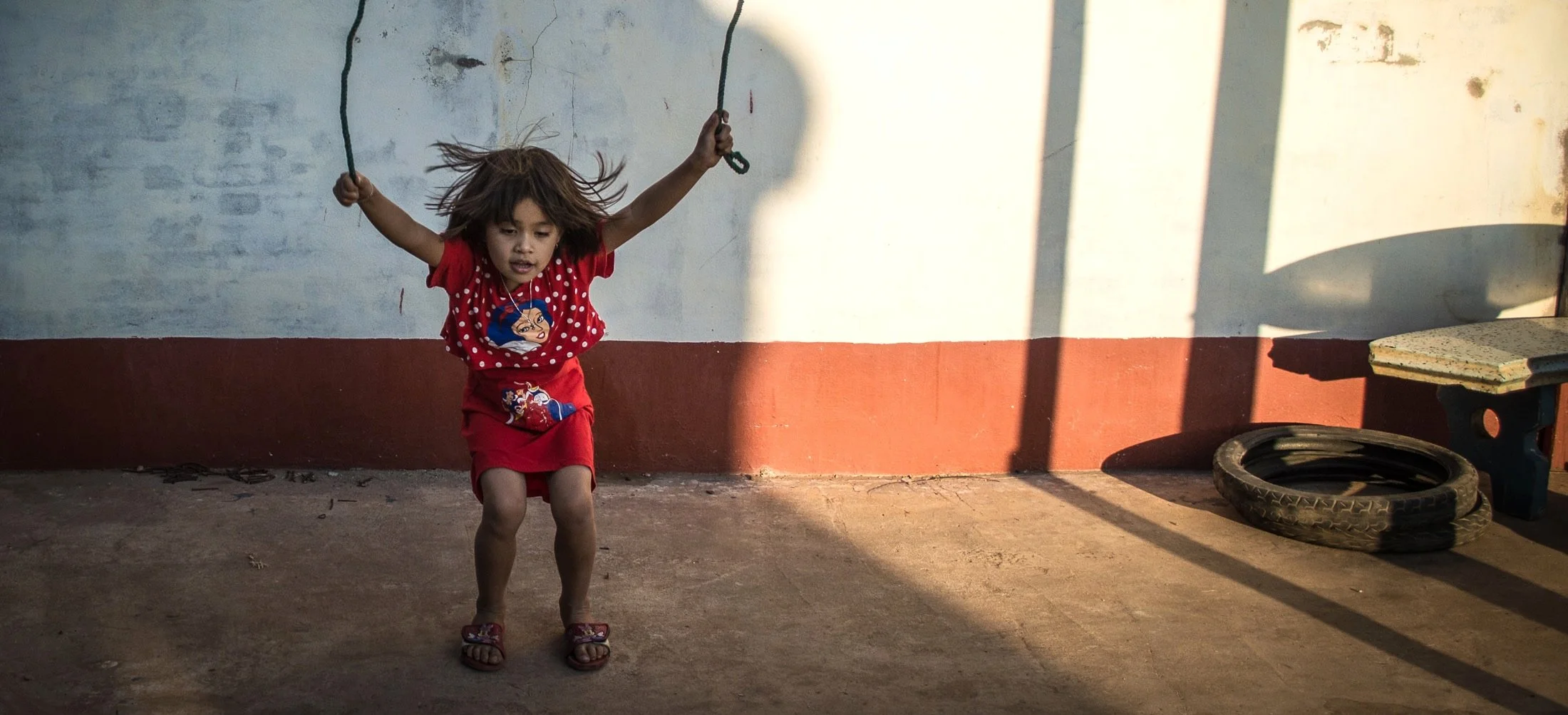
The children are now out of school and playing on the streets, football in open spaces, jumping rope in back alleys. Most kids seem to have perfected their photo pose or "selfie" posture by now. Whereas I remember the "V" for victory in my asian childhood days, the trend now seems to be the inverted "V", flipped appropriately close to your eyes, a cheeky highlight of their best features.


The days in Savannakhet are simple. After months on the road our eye has changed. What excites us and inspires us are the details in the ordinary. Boredom forever escapes us. Life and its patterns, flavours developed from a not-so-easy past, religious relics from afar. Savannakhet's old town may have nothing to get your adrenaline pumping in the conventional sense, no canyoning, kayaking down rapids or mud track bike racing, but when we settle down to an icy cold liquorice spiked pastis (a Pastis! From the South of France! In the middle of Laos!) on the main square at sunset, you can't help but let the charm of this once decadent town rub off on you. And without warning, that's exactly when a hint of familiar adrenaline rushes and pumps up your spine. As we look straight into the horizon, a fiery globe of sunlight is sinking into the "Mother of Water" without a background wave of digital cameras snapping away, only the sound of ice cracking as it melts into one of the last touches left by the French in town.
