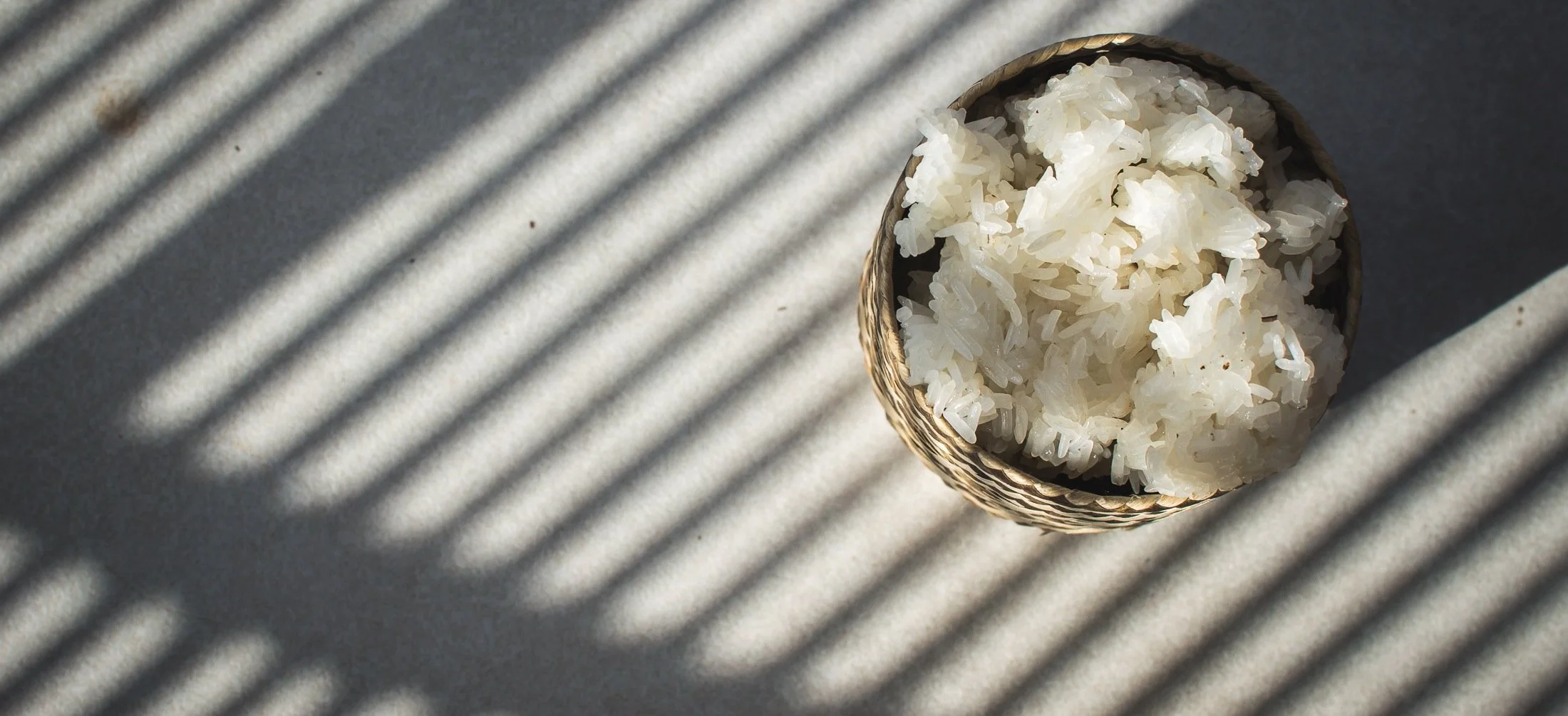

My name is Gabriella and I'm a sticky-rice-aholic.
In fact since leaving Laos, I think I am suffering from a serious case of withdrawal.
It is a relationship that is pure. No fancy contraption is needed, no spoon, fork or chopstick, just you and your ball of sticky rice.
Some people prefer the simple bowl of white rice that we consumed every day in China, each grain a distinct individual, fluffy and light; but glutinous rice (latin: oryza saliva var. glutinosa) a.k.a. sticky rice, doesn't just dissolve in your mouth, it gives your jaws something to work on and rewards you for the hardwork too. It is heavier, heftier and well, gloriously sticky.
It is the default choice of rice in Laos, not an exception to the rule. Except for a few more "recently" migrated groups such as the Chinese Lenten who still prefer using chopsticks and the accompanying long-grain rice, most of the country is digging into baskets of chewy khao niaow. The very essence of being Lao is in the act of eating sticky rice - often they refer to themselves as "luk khao niaow" meaning "the children of sticky rice".
Each mouthful is nutty with coconut undertones and the best part is you can eat it with your hands.
I could eat a small bucket of khao niaow on my own if I wanted to. I wouldn't, but I could.


For many of us, the idea of sticky rice is limited to the well-known Thai dessert - Mango with coconut cream and sticky rice. It is delicious, but so far from being the only way to eat this grain. Lao cuisine is still unknown in most of the world compared to the cooking of some of its more famous neighbours llke Vietnam and Thailand, but many of the Thai dishes that people love and know well like som tam - papaya salad actually originate from the region that is now Laos. I could talk your ear off about other Lao highlights such as the slurp-tastic Khao Poon noodles or the rich Orlam stew, but the most underrated of them all is khao niaow.
Khao means rice and Niaow means sticky. Glutinous rice is grown all over Asia, but the largest proportional percentage of consumption and cultivation is in Laos. The growing of khao niaow has been recorded in the region for at least 1100 years. When everyone else switched to improved non-glutinous rice varieties for higher yields during the Green Revolution, Lao farmers rejected the change and chose to stick to their sticky favourites.
Now before we all put up our gluten-free badges of resistance, khao niaow can happily jump onto the modern trend band-wagon, because despite the misleading name, it is completely gluten-free like any other type of rice. And if you want to add some colour to your dish, it also comes in blacks and purples. Glutinous rice has high amounts of amylopectin which gives the grains their clinging personality, each grain lovingly attached to the other. It is not the most nutrient-rich grain, but oh-so-tasty.

It is also extremely portable. When cooked and cooled, khao niaow is often stored in intricately woven bamboo baskets - tip khao ຕິບເຂົ້າ, ready to be eaten at any time of day. Within the household or at a street food stall, you'll often find a large basket containing rice for the whole day. The variety of basket sizes also meant farmers could take it with them into the fields during the day or fishermen on their river boat. Incredibly filling, sticky rice would sustain them for the day and often it is said it makes you forget your hunger, but don't eat too much at night, because, "it will make you fat." It plays an important role in a nation where subsistence rice farming employs about 85% of the population and produces about 51% of GDP.
There is a whole array of beautiful bamboo accessories associated with khao niaow eating. From the large woven bamboo disc used to separate the grains during harvest to the triangular houat ຫວດ used for steaming, we occasionally saw women carrying the entire line of bamboo appliances needed on their backs.

Khao Niaow is often eaten with pickled vegetables, banana flower soup, bitter water buffalo stew or simply some chilli sauce with boiled green beans. The list of accompaniments is endless and other dishes such as Naem Khao use sticky rice as the main component. A crispy rice salad made of cut up deep-fried sticky rice balls with Lao pork sausage and topped with chopped peanuts, grated coconut, mint, lime juice and coriander, it always leaves you wanting more. Street-side, we got our hands dirty with khao niaow served in thin plastic bags and sunk our teeth into crispy caramel pork chops, with just that hint of smoke, seared on a wooden skewer and wrapped in a fresh banana leaf.
As we took our long bus ride to leave Laos into Vietnam, I had my reassuring plastic bag of khao niaow in my lap, ready to be picked at slowly but surely over the next hours as we drove further and further away from the land of sticky rice. I was ecstatic to devour it plain and simple, with nothing else but the dewy grains to keep me happy.
So I am starting the Sticky Rice Club, in honour of this neglected grain. An ode to its humble glutinous simplicity, this rice needs all the fans it can get. We are not picky, sticky rice and I, anyone who wants to join is welcome! If you are in love with it too, I would love to hear your favourite ways of eating and cooking it, just add your ideas to the comment section below here and let's get steaming. Who's in?


PLAIN & SIMPLE KHAO NIAOW \ˌkʰa᷆w.nǐaw\ ເຂົ້າໜຽວ
Serves 4
2 cups glutinous ricewater for steaming
Soak the rice with enough room temperature water to cover it for a few hours or overnight.
When you are ready to steam it, in Laos they use a houat, a funnel-shaped bamboo basket perched over a deep pot of boiling water, so unless you have one lying around or are using a classic steamer, I find using a metal sieve instead works really well.
For a steamer - If you are using a traditional one like a dumpling steamer, simply place a cheesecloth or a muslin cloth to cover the holes in the steamer and place the soaked rice on top of the cloth. Follow the instructions of your steamer and cook the rice for about 20-30 minutes. During cooking you can shake the rice around a bit to ensure it is evenly cooked through. Don't do this too often though as you want the rice to stay compact.
For a metal sieve - Fill the bottom of a pot with about 2-3 inches of water and place you metal sieve over it. Make sure the pot is the right size to support the metal sieve and make sure you are not using one with a plastic handle. The sieve should not touch the water. Put the soaked rice into the sieve and cover with a lid. Set the pot over high heat until it reaches boiling point, then turn the heat down so that it continues at a steady simmer. Check after 20 minutes and cook longer if necessary until the centre of the grains are cooked through with a slight bite.
Once the rice is cooked, remove from sieve by flipping it over onto a chopping board and using a wooden spatula spread it out a few times to cool down and even out the heat. Roll it back into a large ball and store in a bamboo basket tip khao or in a bowl covered with a tea towel until you are ready to eat.
Now dig in with your hands! Or try it with our spicy Laos jungle papaya salad.
